

What Is a Multi Vendor Ecommerce Website?
A multi vendor ecommerce website is an online marketplace where many independent sellers list and sell their products on one platform. Customers browse and buy from all of them in one place, with one cart and one checkout.
You own and run the platform. Sellers bring the products and handle their own stock and shipping — you earn a share of every sale. It is the same model behind Amazon, Flipkart and Meesho, built at a scale that fits a small founder.
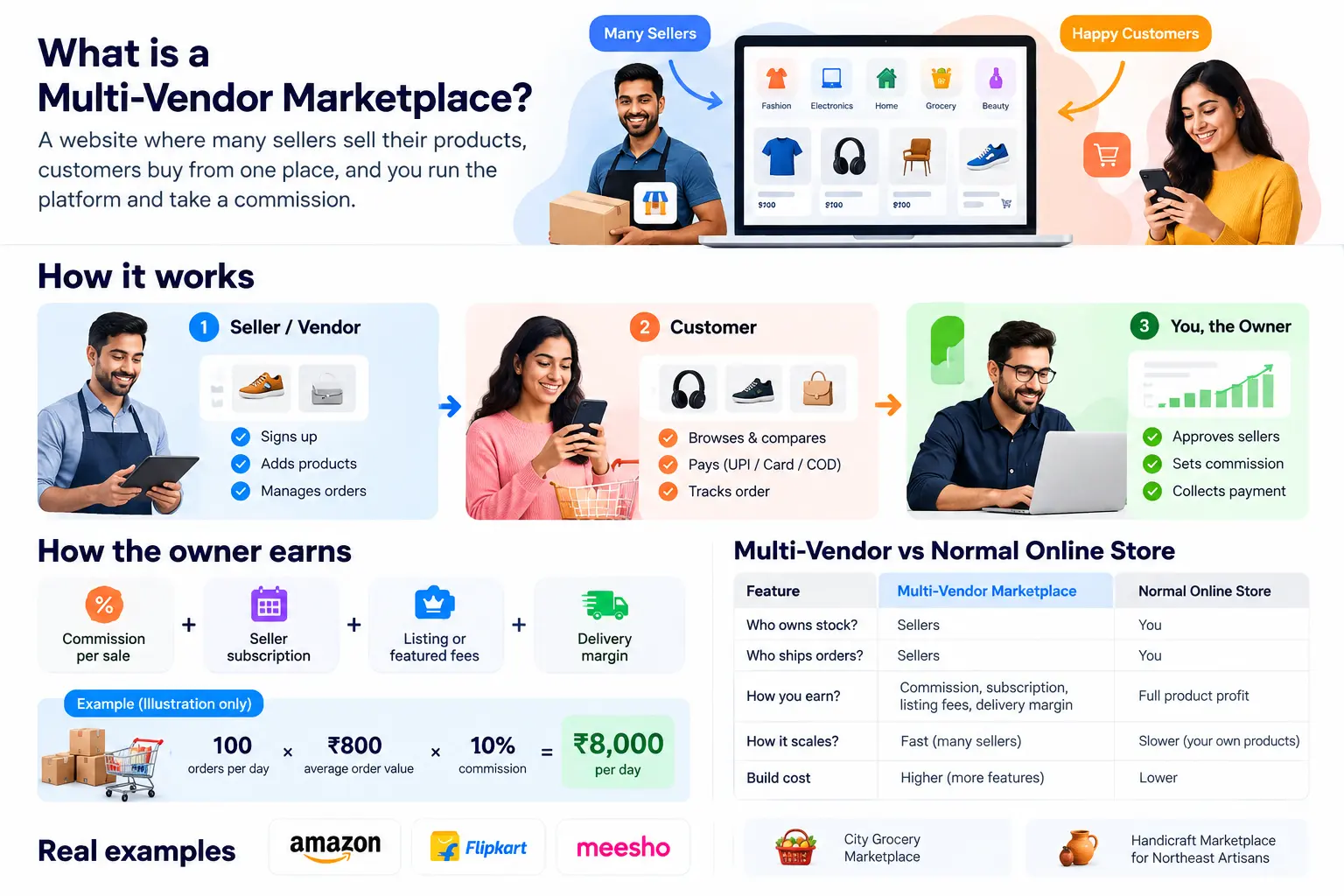
Three Roles, One Platform
Every order on a marketplace involves three people. Your website gives each of them exactly the tools they need.
The Seller
Runs their own shop inside your marketplace
- Signs up and gets a personal seller dashboard
- Adds products, prices, photos and stock
- Sees their own orders and ships them
- Tracks sales and earnings after commission
The Customer
Shops from every seller in one place
- Browses and compares products across sellers
- Pays by UPI, card, net banking or cash on delivery
- Tracks the order until it arrives
- Leaves reviews that help other buyers
You, the Owner
Runs the platform and earns on every sale
- Approves which sellers can join
- Sets commission rates and platform rules
- Collects customer payments in one account
- Pays sellers their share after commission
How the Owner Earns
You don’t buy stock, store products or pack orders. Revenue comes from the activity on your platform — usually from more than one of these at once.
-
Commission per sale
A percentage of every order goes to you before the seller is paid. This is the main income for most marketplaces.
-
Seller subscriptions
Sellers pay a monthly or yearly fee to keep their store active on your platform.
-
Featured listings
Sellers pay extra to appear at the top of categories or on the homepage.
-
Delivery margin
A small difference between what customers pay for delivery and what shipping actually costs.
100 orders a day × ₹800 average order × 10% commission = ₹8,000 a day — earned without holding a single product. These numbers are only an example to show how the model works; real results depend on your sellers, your category and how you market the platform.
Multi-Vendor Marketplace vs a Normal Online Store
Not sure which one you need? The difference comes down to who owns the products.
| Multi-Vendor Marketplace | Normal Online Store | |
|---|---|---|
| Who sells | Many independent sellers | Only you |
| Who owns the stock | Each seller | You |
| Who ships orders | Each seller | You |
| How you earn | Commission, fees, subscriptions | Profit on each product sold |
| How it grows | Add more sellers | Add more of your own products |
| Starting cost with us | ₹12,500 + GST | ₹7,500 |
Selling only your own products? A normal store is simpler and cheaper — see our ecommerce website design page. Planning to bring other sellers on board? A marketplace is the right build.
Marketplace Ideas That Work at a Small Scale
- City grocery marketplaceLocal shops list products, customers order for home delivery
- Handicraft marketplaceArtisans from one region sell handmade products nationwide
- Organic & farm produceFarmers and small brands sell directly to buyers
- Fashion & boutique hubLocal boutiques and home sellers under one brand
- Electronics & spare partsMultiple dealers compete on price and stock
- Books & study materialPublishers, sellers and resellers in one catalogue
Why Build a Marketplace Instead of a Normal Store?
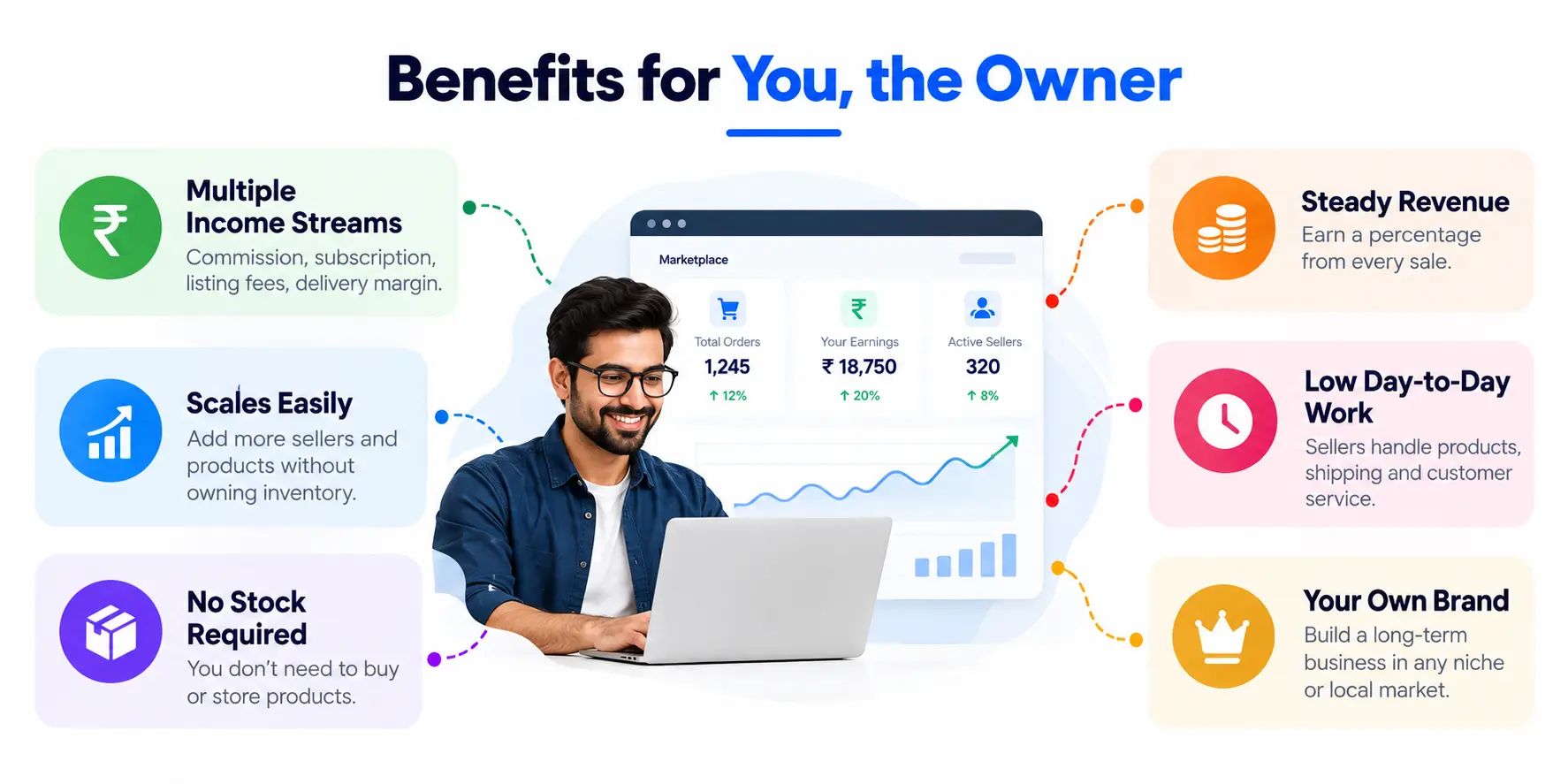
A normal online store grows only as fast as you can buy stock. A marketplace grows as fast as you can bring sellers on board — and every seller adds products, customers and revenue without adding cost to you.
-
01
No inventory, no stock risk
Sellers buy, store and ship their own products. You are never left holding unsold stock, and you don’t need lakhs of rupees tied up in goods before you can start.
-
02
Grow by adding sellers, not stock
Every new seller brings their own catalogue. Your marketplace can go from fifty products to five thousand without you spending anything on inventory.
-
03
Sellers bring their own customers
Sellers share their store links on WhatsApp, Instagram and with regular buyers. Every one of those visits lands on your platform, not theirs.
-
04
Win the niche the giants ignore
Amazon and Flipkart serve everyone. A marketplace focused on one city, one region or one product type can offer local trust, local delivery and curated sellers they can’t match.
-
05
You own the customers and the brand
Selling on someone else’s marketplace means renting their customers. On your own platform, every buyer’s details and every repeat order belong to your brand.
-
06
More than one income stream
Commission on sales, seller subscriptions and paid featured listings can all run together — so income doesn’t depend on one source.
What a Marketplace Needs From You
The website makes a marketplace possible. Making it work is on the owner. Before you start, be ready for these four things.
- Your first sellers Customers won’t come to an empty marketplace. Plan to personally onboard your first ten to twenty sellers before launch.
- Quality control One bad seller hurts your whole brand. You approve who joins and act on complaints quickly.
- Payouts and disputes Paying sellers on time and settling returns fairly is what keeps them on your platform.
- Marketing A new marketplace needs traffic. Ads, social media and seller promotion bring the first buyers in.
Multi Vendor Marketplaces We’ve Actually Built
Real marketplace projects, each one filmed and published on our channel — from Amazon-style stores to B2B supplier marketplaces like IndiaMART. Watch the seller dashboards, vendor sign-up and buyer flow working on live websites before you decide anything.
 ▶ Watch the full project
Brooch Industries — B2B Marketplace for Metal & Scrap, Like IndiaMART
An enquiry-based B2B marketplace where verified suppliers list metals, scrap, industrial components and EV parts, and buyers request quotes — with live daily metal rates on the homepage.
- Marketplace Type
- B2B supplier marketplace (enquiry & quote based)
- Key Features
- Supplier registration & dashboard, Post Requirement, Get Quote, live metal & scrap rates, shipment tracking
- Client Location
- Chhatrapati Sambhaji Nagar, Maharashtra
 ▶ Watch the full walkthrough
Complete Multivendor Marketplace on Dokan + WooCommerce
A full marketplace build from start to finish — the storefront customers shop from, the vendor stores inside it, and the dashboards sellers use to run their own shop.
- Built With
- WordPress, WooCommerce and Dokan
- Marketplace Type
- Multi-seller online marketplace
- Video Covers
- Vendor stores, seller dashboard and the customer shopping flow
-
 ▶ Watch
Cashback Wallet
▶ Watch
Cashback WalletMultivendor Store with a Cashback Wallet
How the vendor system and the customer cashback wallet work together, end to end.
Watch on YouTube → -
 ▶ Watch
Live Review
▶ Watch
Live ReviewMulti Vendor Ecommerce Website — Live Review
A walkthrough of a live marketplace and how it was developed, page by page.
Watch on YouTube → -
 ▶ Watch
Video in Hindi
▶ Watch
Video in HindiMultivendor Ecommerce Website Demo
A full demo of a multivendor marketplace and how we developed it, explained in Hindi.
Watch on YouTube → -
 ▶ Watch
Video in Hindi
▶ Watch
Video in HindiMarketplace Like Amazon & Flipkart
How an online shopping marketplace in the style of Amazon and Flipkart is built.
Watch on YouTube →
More marketplace and ecommerce builds are published every week on our YouTube channel.
Documents Required for a Multi Vendor Ecommerce Payment Gateway
To accept online payments, your marketplace needs a payment gateway account — and the gateway needs to verify who you are. The good news: you can start with just two documents, and upgrade to your brand name whenever you are ready.
Which documents you need depends on one thing: are you starting as an individual, or as a registered business? Either way, customers can see your marketplace brand name when they pay.
Starting as an Individual
No company registration yet? You can still accept payments. The gateway account is opened in your own name, and payments settle into your personal bank account.
- Aadhaar Card Confirms your identity and address.
- PAN Card Required for any financial account in India.
On Razorpay and Cashfree you can still show your marketplace brand name at checkout, even as an individual.
As a Registered Business
Payments settle into your company’s current account, and GST on sales is handled under your business — cleaner accounts for a growing marketplace.
- Company GST Certificate Shows you are registered under GST and can collect tax on sales.
- Current Account in the Company’s Name Where your payment collections are settled.
- MSME Certificate Confirms your business as a registered micro, small or medium enterprise.
- Company PAN Card Needed for the business’s financial transactions and tax.
Business settlements, GST billing and your brand at checkout.
These are our partner referral links — the gateway may reward us if you sign up through them. It costs you nothing extra, and the account is fully yours, in your own name.
What the Gateway Checks on Your Website — We Set This Up
Documents are only half of it. Payment gateways also review the website itself before approving it. These are included in your build, so approval doesn’t get stuck.
- Privacy policy page
- Terms & conditions page
- Refund & cancellation policy
- Shipping & delivery policy
- Contact details and business address
- Clear product pricing on every listing
Exact requirements can vary between payment gateway providers. Showing a brand name on an individual account is available on Razorpay and Cashfree; other gateways may differ. We guide you through the application for whichever gateway you choose.
What Your Multi Vendor Marketplace Looks Like From Every Side
Real screens from a marketplace we built. Follow one order through the platform — from the seller adding a product, to you managing the order, to the customer checking out.
Seller Side
What your vendors use to run their shop inside your marketplace.
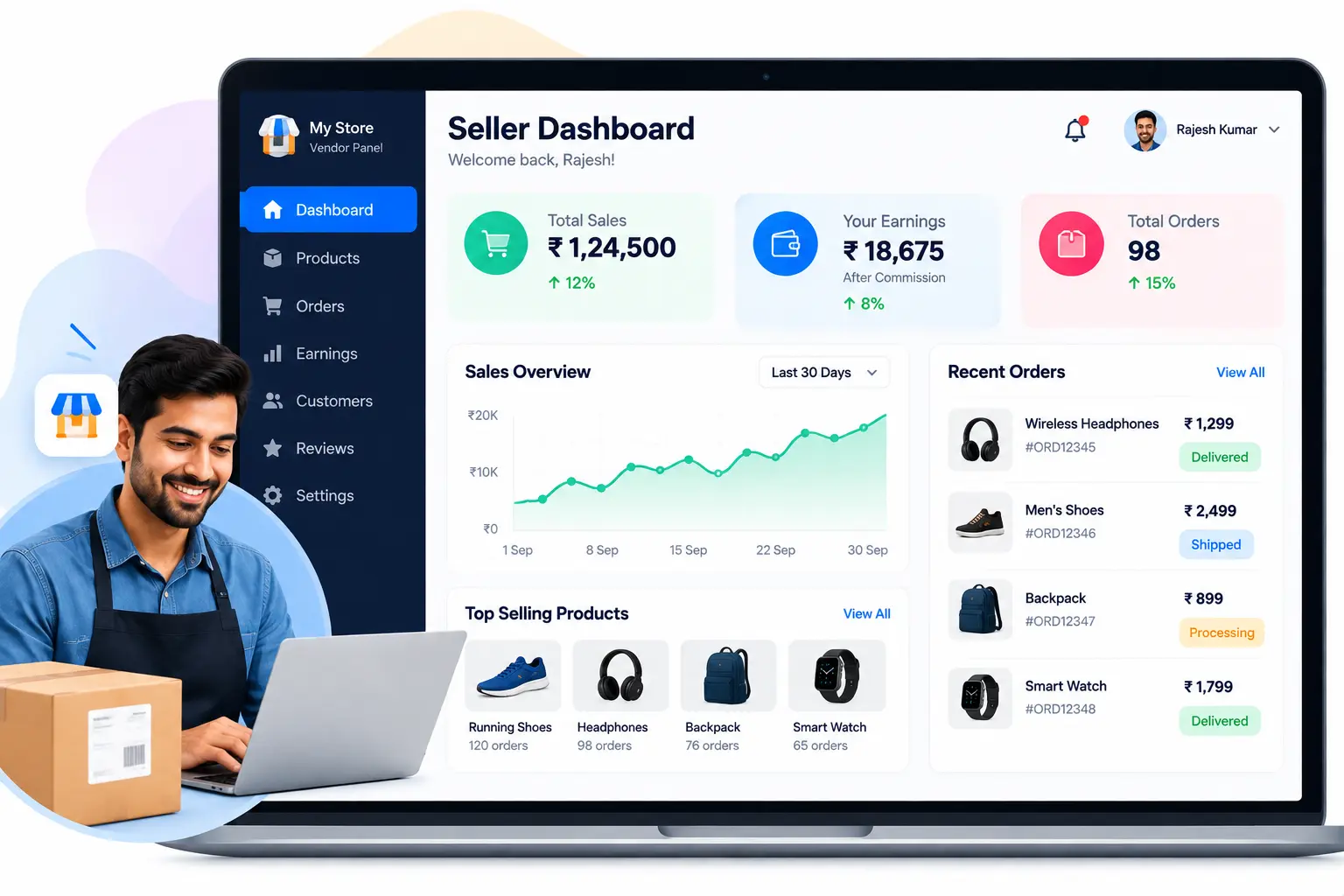
Seller Dashboard
What each seller sees after logging in — their sales, earnings after commission and latest orders.
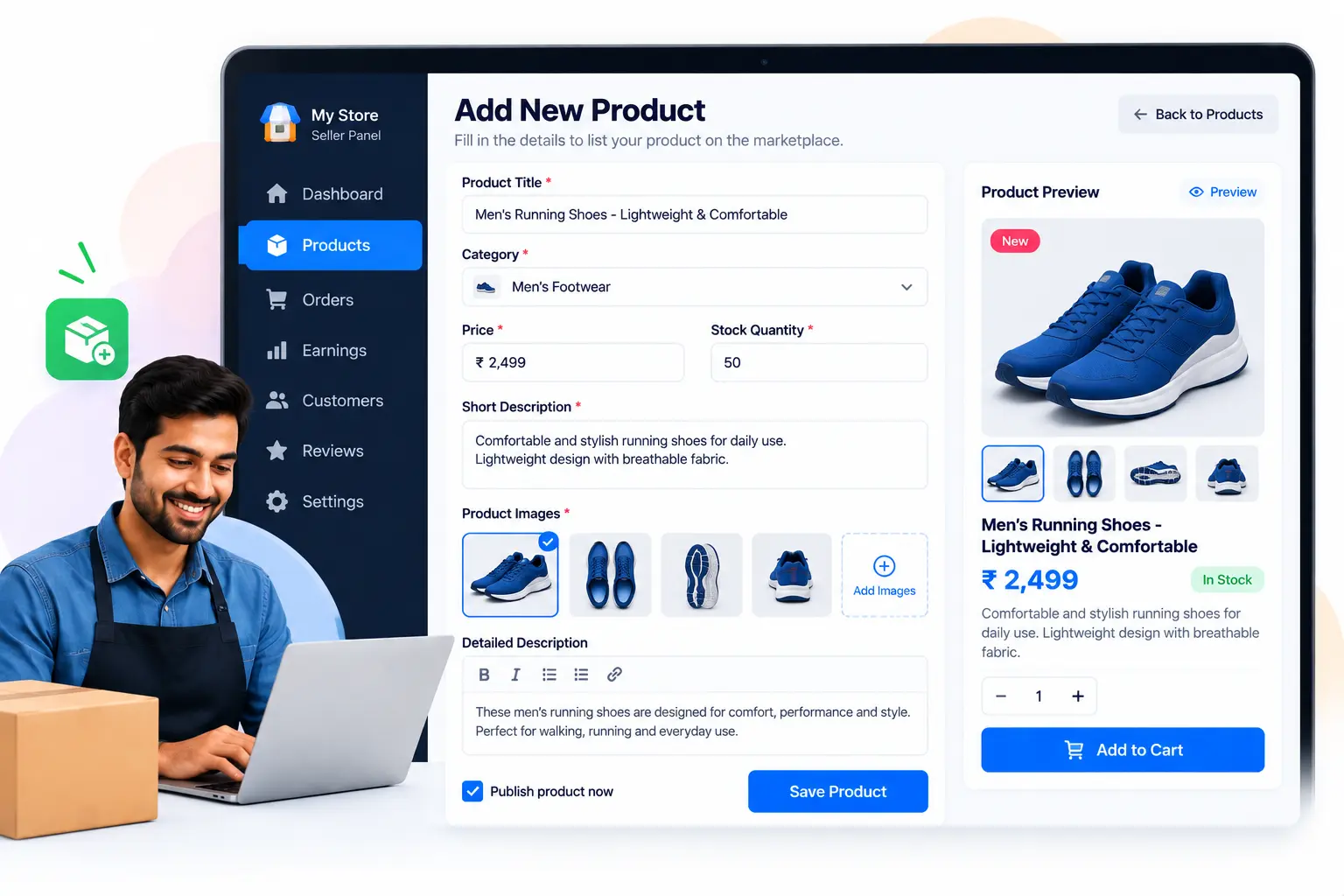
Add Product Form
Sellers add their own products from the front end — photos, price, stock and category — without admin access.
Owner Side
How you stay in control of sellers and orders across the whole platform.
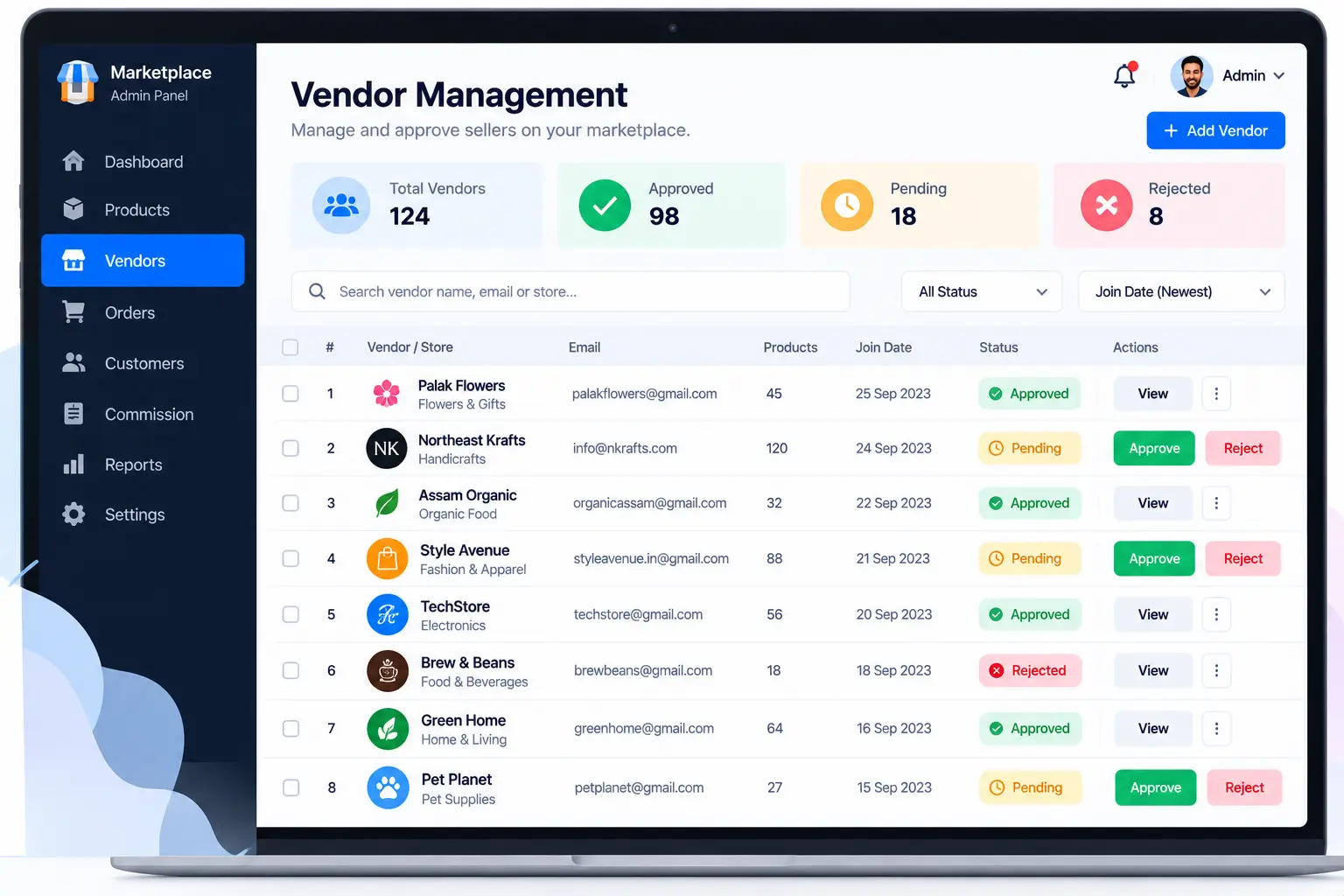
Vendor Approval
You decide who sells on your marketplace. New sellers wait for your approval before their store goes live.
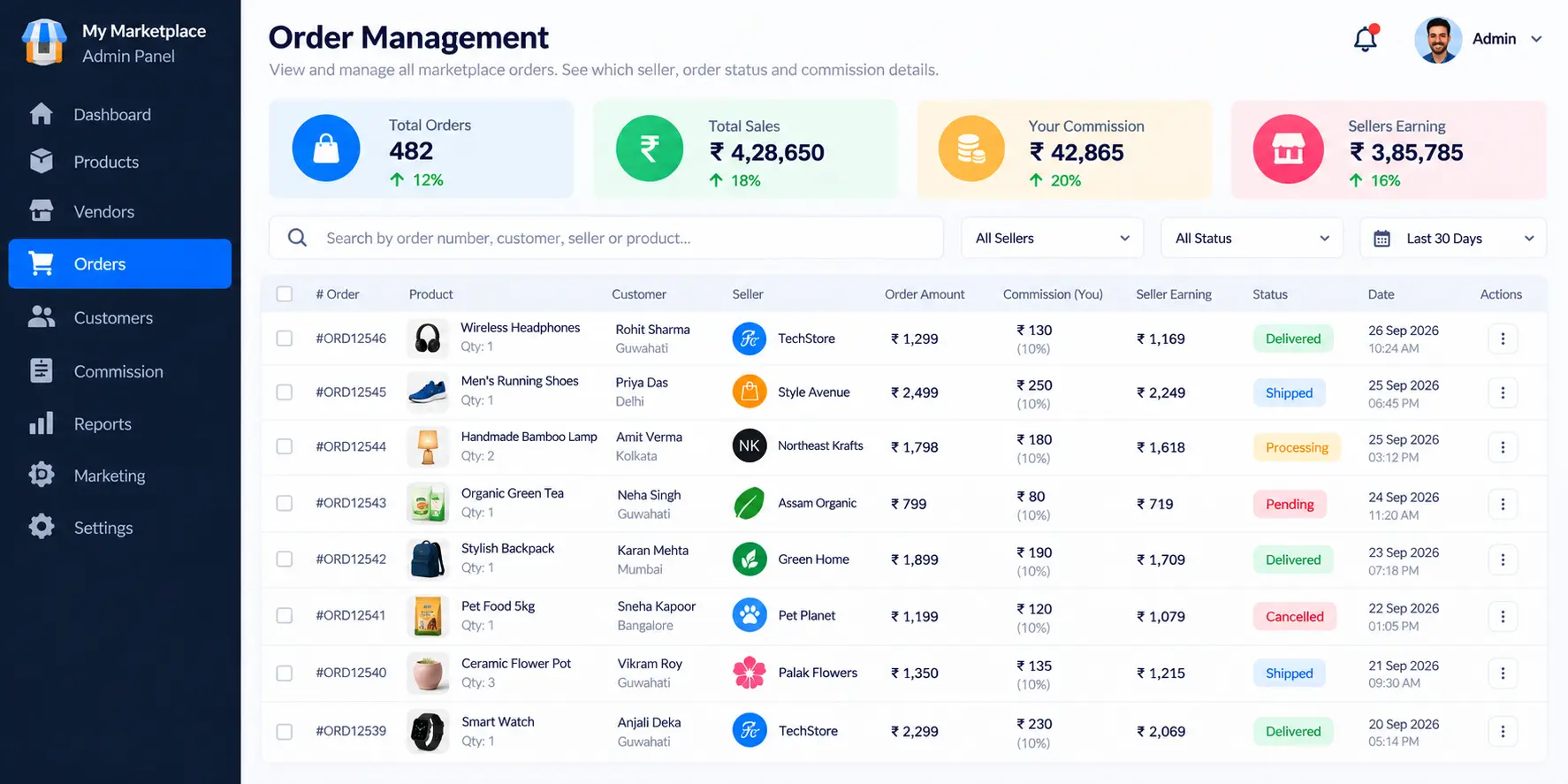
Order Management
Every order from every seller in one place, with its status and the seller it belongs to.
Customer Side
What your buyers see — one store, many sellers, one easy checkout.
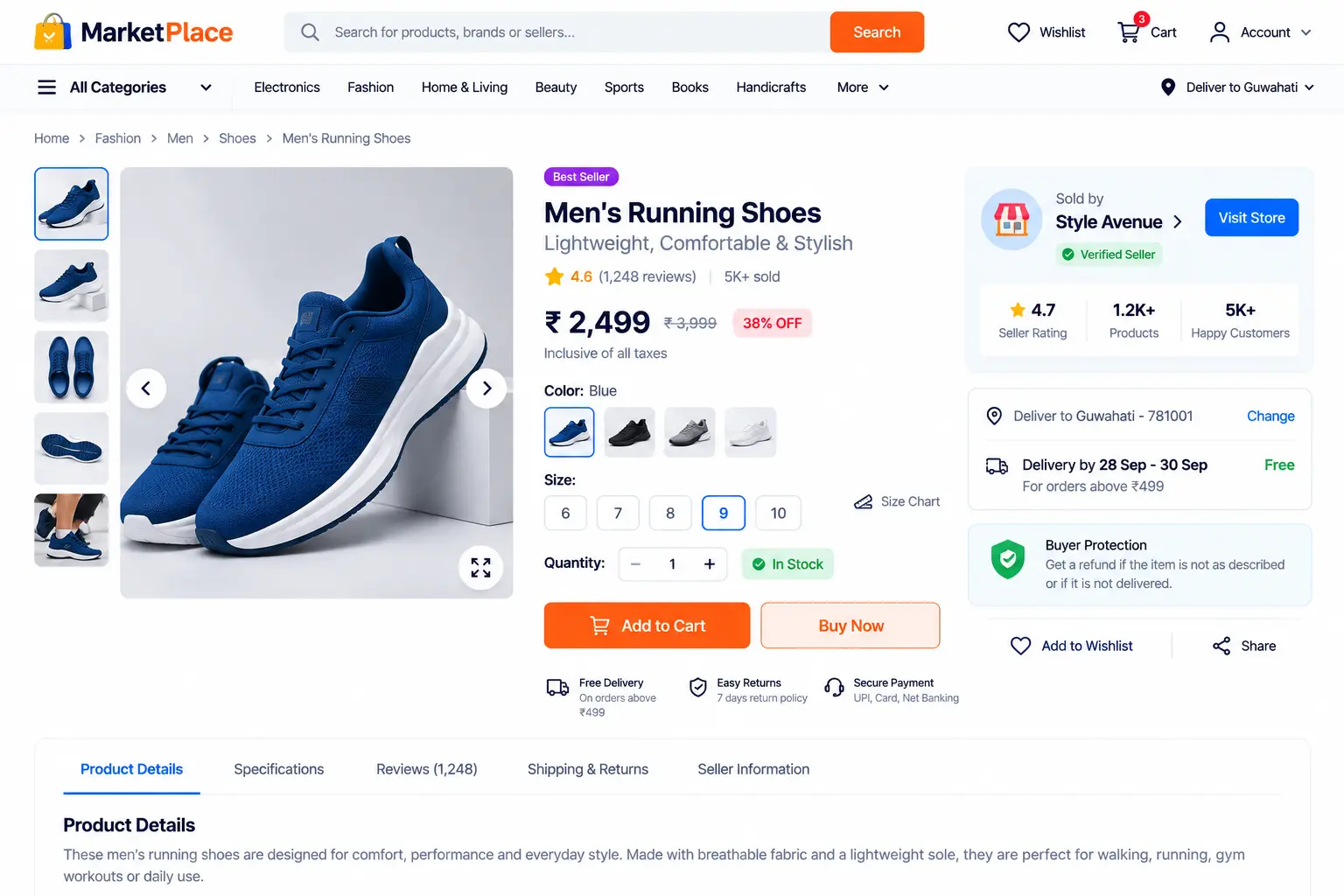
Product Page with “Sold By”
Customers see which seller they are buying from — the clearest sign it’s a marketplace, not a single store.
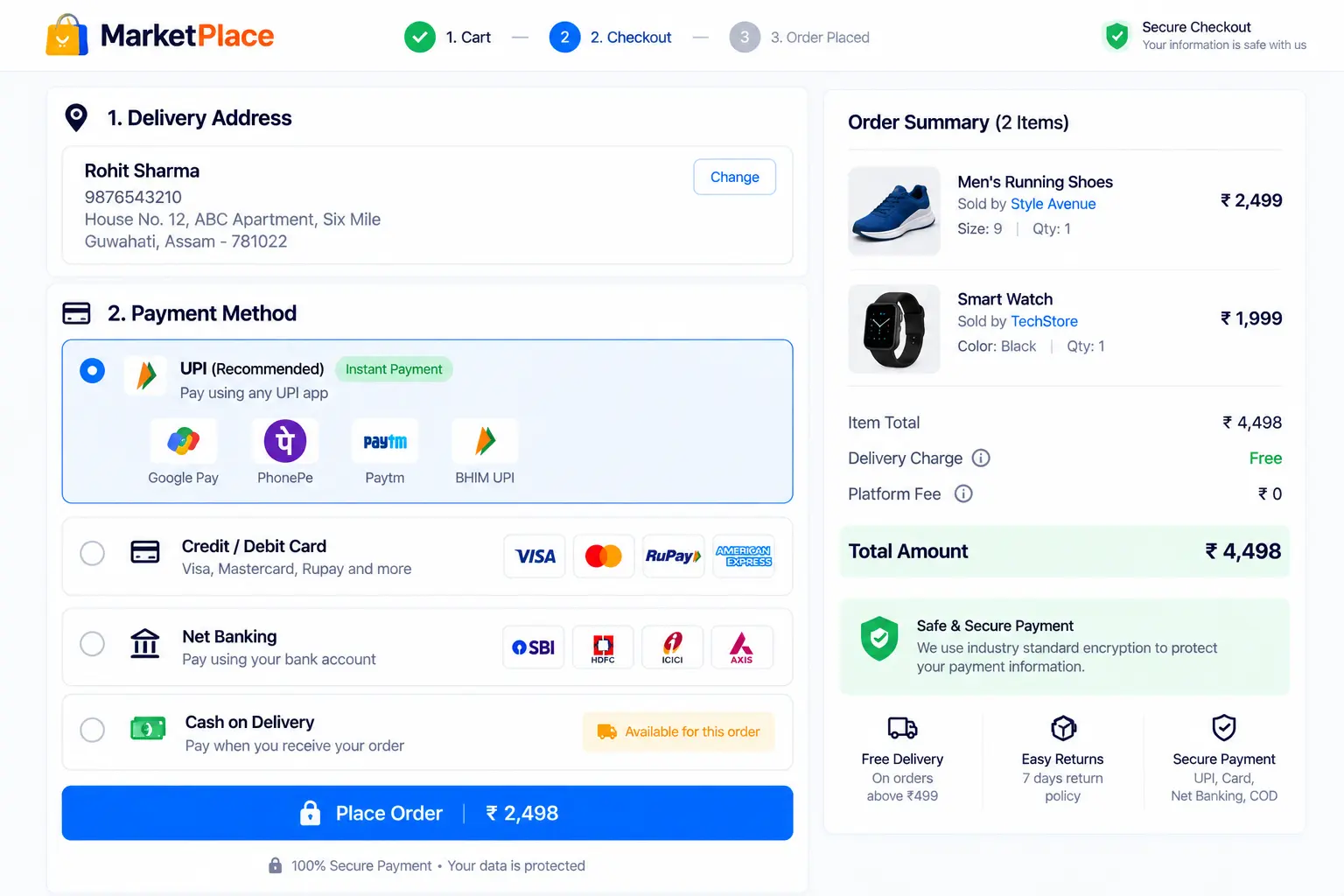
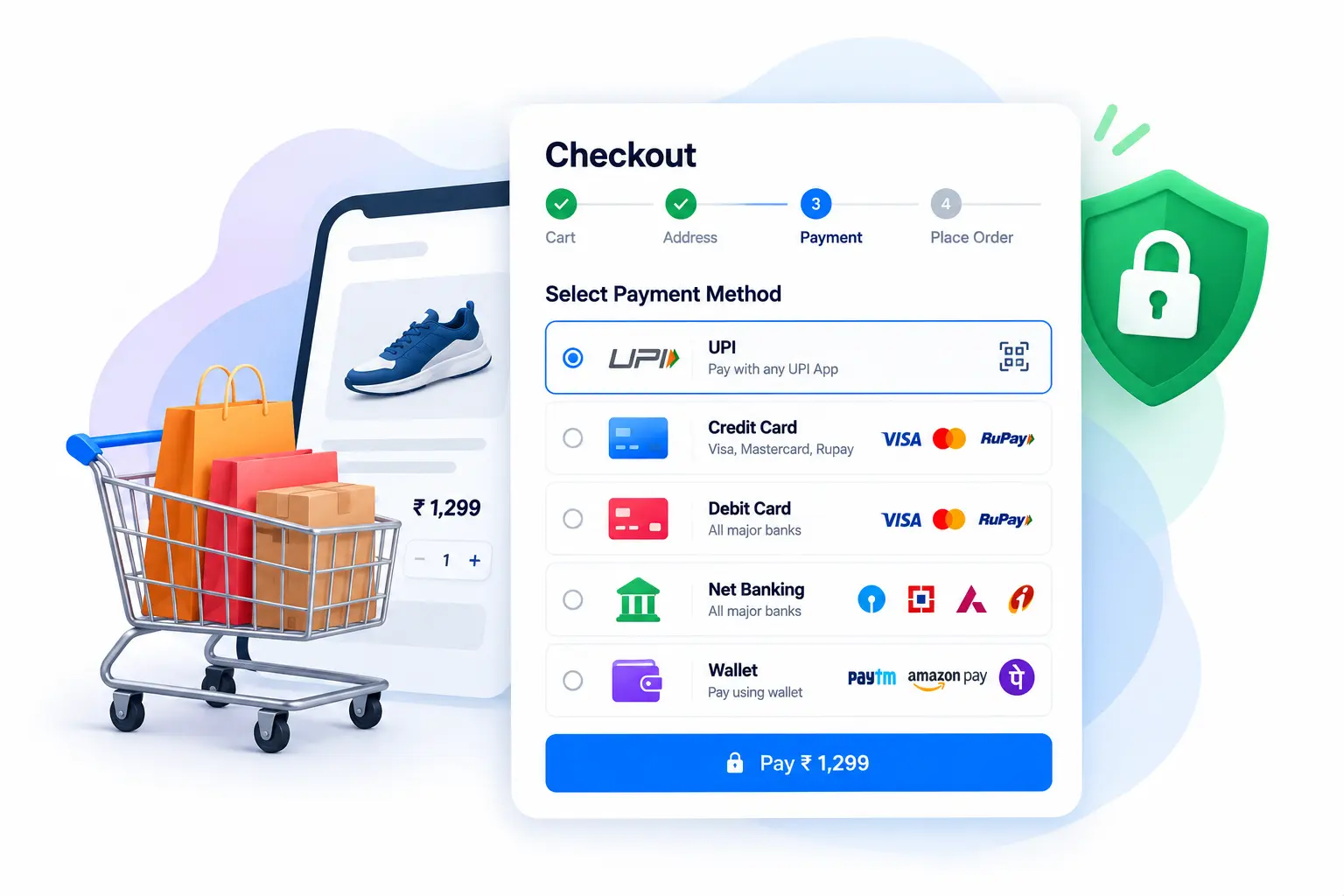
Checkout
One checkout for products from different sellers, with UPI, cards and cash on delivery.
Tap any screenshot to open it full size. Customer details in these screens have been hidden for privacy.